



Intel and the Birth of the Microprocessor
The computers, smartphones, automobiles, internet infrastructures, and artificial intelligence systems we use today owe a great deal to a single technological invention: the microprocessor.
At the center of this revolution is Intel. Founded in 1968, Intel is considered not only a semiconductor manufacturer but also one of the cornerstones of the modern digital age.
There are billions of transistors inside the device you are currently using to read this article. From your smartphone to your automobile, almost every electronic and technological product in the modern world operates thanks to microprocessors. So how and where did this revolution begin? The answer takes us to a small chip developed by Intel in 1971.
What Is a Microprocessor?
A microprocessor is the central processing unit of a computer (CPU – Central Processing Unit). Simply put, it is the brain of the computer.
A microprocessor;
- Processes data,
- Performs mathematical operations,
- Interprets program instructions,
- Manages communication between hardware components.
The computers, phones, smart televisions, automobiles, and even household appliances we use today operate thanks to microprocessors.
Before the 1970s, the processing tasks of a computer were carried out by many electronic circuits. With the development of the microprocessor, all of these functions could be gathered on a single silicon chip.
This development is considered one of the most important turning points in the history of technology.
The Founding of Intel (1968)
Intel was founded in 1968 by Robert Noyce and Gordon Moore in Mountain View, California, USA. The company’s headquarters are still located in the same region today, in Santa Clara.
Derived from the phrase “Integrated Electronics,” Intel’s founders had previously worked at Fairchild Semiconductor and achieved significant success in the semiconductor industry. The aim of their new company was to make electronic components smaller, faster, and more powerful.
This vision would later turn into one of the world’s greatest technological revolutions.
The World’s First Commercial Microprocessor: Intel 4004
On November 15, 1971, Intel introduced the Intel 4004, which is considered the world’s first commercial microprocessor.
The Intel 4004:
- Had a 4-bit architecture.
- Contained approximately 2,300 transistors.
- Operated at 740 kHz.
- Provided full processor functionality on a single chip.
Developed for the Japanese calculator manufacturer Busicom, this processor later changed the direction of the entire computer industry.
The most important feature of the Intel 4004 was that it could perform, on a single programmable chip, operations that had previously been carried out by many electronic circuits. For this reason, technology historians regard the Intel 4004 as one of the products that launched the computer age.
Intel 8086 and the Personal Computer Revolution
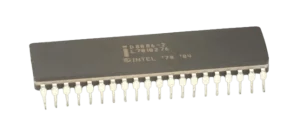
Intel’s second major success was the Intel 8086 processor, introduced in 1978.
The 8086 processor:
- Had a 16-bit architecture.
- Offered higher performance.
- Formed the foundation of the x86 architecture, which is still used today.
In 1981, IBM decided to use the Intel 8088 processor in its first personal computer.
This decision is considered one of the most important commercial decisions in the history of technology.
Thanks to the collaboration between IBM and Intel, personal computers began to spread worldwide.
Intel and the Rise of the Digital Age
From the 1980s onward, Intel shaped the computer market by developing the following processors:
- 286
- 386
- 486
- Pentium
Thanks to these processors:
- Home computers became widespread.
- Internet usage increased significantly.
- The software industry grew.
- Computer costs decreased.
Today, technologies developed by Intel form the basis of billions of devices, from data centers to laptop computers.
Why Is Intel So Important?
Intel’s importance does not come only from producing processors.
The company:
- Started the microprocessor revolution.
- Enabled the spread of personal computers.
- Created the hardware foundation of the internet age.
- Accelerated the development of data centers.
- Paved the way for artificial intelligence and high-performance computing.
If the microprocessor had not been developed, the computers, smartphones, and modern internet ecosystem we use today might have been in a very different place.
What Is Moore’s Law?
When discussing Intel’s contributions to technology, it is impossible not to mention Moore’s Law. Gordon Moore noticed that the number of transistors in integrated circuits roughly doubled every two years. This prediction was later called “Moore’s Law” and became one of the key concepts explaining the pace of technological development for more than half a century.
Transistors are the fundamental building blocks of modern electronic devices. The more transistors a processor contains, the faster that processor can perform more complex operations. Thanks to Moore’s Law, computers continuously became more powerful, smaller, and cheaper. Intel’s first commercial microprocessor, the Intel 4004, developed in 1971, had only 2,300 transistors.
Moore’s Law affected not only the development of computers, but also many fields from smartphones and internet infrastructure to artificial intelligence systems and space technologies. The continuous increase in processing power enabled software developers to design more complex programs and allowed new technologies to emerge.
Developments in recent years suggest that Moore’s Law may be approaching its physical limits. The coming years will show how this will affect the technology sector. Transistors have shrunk to the nanometer scale, and physical limits have begun to make production processes much more difficult. Energy consumption, heating problems, and production costs are raising concerns across the industry.
Despite this, technology companies continue to develop new methods to sustain progress. Multi-core processors, artificial intelligence accelerators, three-dimensional chip designs, and quantum computers are among the main examples of these efforts. Therefore, even though Moore’s Law no longer operates as rapidly as it once did, it continues to be one of the fundamental ideas guiding the development of computer technology.
In conclusion, Moore’s Law played a very significant role in the formation of the modern digital world. It guided the development of computer technologies for decades. Although new technologies today are advancing through different paths, the vision put forward by Moore is still regarded as one of the most important milestones in the history of technology.
Conclusion
Founded in 1968, Intel changed the course of technology history with the Intel 4004 microprocessor it developed in 1971.
Thanks to the microprocessor, computers became smaller, cheaper, and accessible to millions of people.
Today, the foundations of the digital world, extending from artificial intelligence to cloud computing, are based on the steps Intel took more than half a century ago.
Although Intel is one of the companies that started the microprocessor revolution, today it faces intense competition from companies such as AMD, NVIDIA, TSMC, Samsung, and Apple. Especially in the age of artificial intelligence, NVIDIA’s rise and AMD’s success in the processor market have made the semiconductor industry more competitive.
For this reason, Intel is not only a technology company, but also one of the leading companies regarded as an architect of the modern digital age.